

Published by Aloto Naga | November 2, 2025
A new controversy has surfaced in Nagaland. This follows details of the Rashtriya Gram Swaraj Abhiyan (RGSA) recruitment under the Rural Development Department being made public through a Right to Information (RTI) request. The revelations have raised questions about possible bias and irregularities in the selection process for 74 posts advertised under the Block Panchayat Management Unit (BPMU) of RGSA earlier this year. The RGSA is a Central Government scheme designed to strengthen rural governance. It aims to empower local bodies across India. In Nagaland, the programme is implemented by the Rural Development Department. This department conducted written exams and interviews for the recruitment in May 2025.
RTI Brings Hidden Data to Light
When the department initially announced the results, it published only the roll numbers of selected candidates, omitting their names, marks and etc,. However, following suspicions of procedural lapses, an applicant filed an RTI demanding transparency. The department at first refused to share the details, citing privacy concerns. Also Read Zunheboto Resolution Unites Naga Groups
After an appeal to the First Appellate Authority (FAA), officials of the Rural Development Department reportedly reviewed the matter. They admitted their earlier “misunderstanding.”
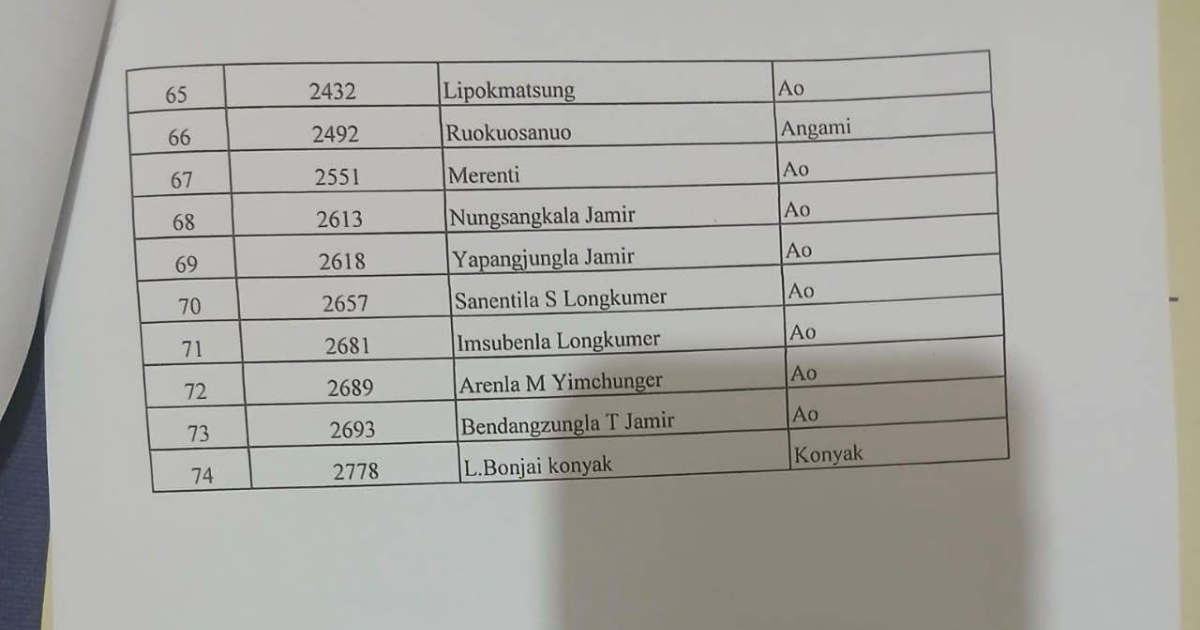
Subsequently, the department released the full list of names, roll numbers, tribes, and marks obtained by the selected candidates. The data, now shared publicly on social media, shows a stark imbalance in tribal representation among the selected 74 candidates.
Our Network

Majority of Posts Secured by One Tribe
According to the list, the distribution of the selected candidates by tribe is as follows:
-
Ao – 39
-
Konyak – 10
-
Lotha – 9
-
Angami – 8
-
Chakhesang – 4
-
Sema – 1
-
Khiamniungan – 1
-
Rengma – 1
-
Pochury – 1
The disproportionate number of candidates from a single tribe 39 out of 74 has led to widespread discussion online, with citizens demanding explanations from the department. Critics argue that such an imbalance is unlikely in an open, merit-based examination and may reflect internal bias or misuse of selection criteria. Also Read Surumi Servants of God: Global Missionaries, Pastors & Theologians
Citizens Question Fairness of Process
Several social media users and civil society observers have described the outcome as “deeply concerning,” particularly in a state as ethnically diverse as Nagaland. “If recruitment is meant to empower rural governance under a national scheme, then it must reflect fairness across all communities,” wrote one commenter believed to be the RTI applicant who first exposed the data.
Others questioned whether the recruitment followed the reservation roster properly. They wondered if tribal identity played an undue role in the final selection. The Rural Development Department has not yet issued an official clarification regarding these allegations.
Understanding the RGSA Scheme
The Rashtriya Gram Swaraj Abhiyan (RGSA) is a flagship initiative of the Ministry of Panchayati Raj, Government of India. It aims at strengthening rural local bodies through capacity-building and administrative support.
Under this scheme, state governments receive central funding to improve governance efficiency at the Gram Panchayat, Block, and District levels. For northeastern states like Nagaland, the Centre funds 90% of the programme, while the state contributes 10%. Recruitment under RGSA is intended to be merit-based and transparent. Officials are trained to handle planning, implementation, and monitoring of village development programmes.
Call for Transparency and Review
The disclosure of tribe-wise selection data has renewed public calls for transparency and accountability in government recruitments. Activists and youth organizations have urged the government to review the entire RGSA recruitment process. They demand the publication of the complete merit list of all candidates to ensure fairness.
Observers note that if the irregularities are proven true, the issue could undermine public trust in future rural development initiatives. It would reflect poorly on state-level administration of central schemes. For now, the public awaits an official response from the Rural Development Department, Nagaland, regarding the RTI findings.
